
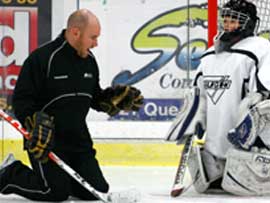
Enjoy this guest post by Brady Robinson: Development Goalie Coach of the Philadelphia Flyers, NHL, West Coast Hockey Prep Camp Lead Goalie Coach, and designer of our Goalie Drills for Teams.
As we all know, goaltenders get neglected in most hockey practices. These 5 tips make practice great for goalies too. A goalie does not need a goalie coach 1 on 1 every single practice in order to develop. A great hockey coach can manage, and develop great goalies with exceptional practice habits. In fact the following tips don’t require more goalie specific training than you can learn over coffee with a goalie coach. The complete season of goalie drills in the above link provides drills that a competent assistant coach can manage. They even incorporate shooters to keep practice active, focused, and filled with purpose.
[maxbutton id=”2″ url=”https://www.lgsports.ca/downloads/hockey-goalie-drills-teams/” text=”30 weeks of goalie drills for teams” ]
Brady’s 5 Tips for Managing Goaltenders:
-
Provide the goaltenders 10 minutes at the beginning of each practice to focus on goaltender specific movement skills. You should assign two crease patterns each practice. Explain the patterns to the goalies prior to the ice-time to ensure they understand the drills.
-
Ensure that the majority of drills throughout the practice allow the goaltenders to complete their entire save process. 1. Shot Preparation, 2. Save Execution, and 3. Recovery. A lot of the time drills force goalies to rush. The goalie can’t properly set for shots or square up to rebounds. A goalie’s success in a game depends on these 2 habits. They require a lot of repetitions during practice.
-
Involve the goaltenders in pre-drill discussions. After describing the drills to the team, give the goaltenders one specific area of focus for that particular drill. Example 1. Drill focusing on 2 on 1’s – let the goaltenders know that they need to be vocal with their defensemen.
Example 2. Warm-up drill – tell the goaltenders that they need to complete their save process for every shot. -
Always encourage the goaltenders to communicate with teammates and to handle the puck whenever possible. A goaltender needs to take charge of both these areas and should be encouraged to do so, especially in practice.
-
Treat your goaltenders the same way you treat the rest of the team and don’t be afraid to call them out. If you feel they are not competing the way they should be, hold them accountable and don’t let them off the hook.
Learn With Us…
 We explore strategies and tactics in easy to digest video tutorials at www.howtoplayhockey.ca. Join us today to learn the game.
—
All of what you have posted is great. Head coaches don’t seem to care that the drills are there for the goalies as well.
There is a young goalie who can’t get a break because he is not a “pedigree” goalie. Didn’t go to a D-1 School, didn’t play in the NAHL, WHL or OHL, but plays better during the drills than the regular goalie. How does a goalie like this get a “look”? How do they get discovered…?
One such goalie was the backup goalie for the Fayetteville Fireantz in the SPHL. He played much better on a daily basis than the starting goalie… and come to find out, he was doing this on 3 hours of sleep because he had to work at a bar as a bartender all night before the practices because he had to pay for gas and rent and food, etc.
His name is Chris Zeitler, from Raleigh, NC – he is 5’11” and 195lbs. How does someone like him get a break? What drills will get him seen?